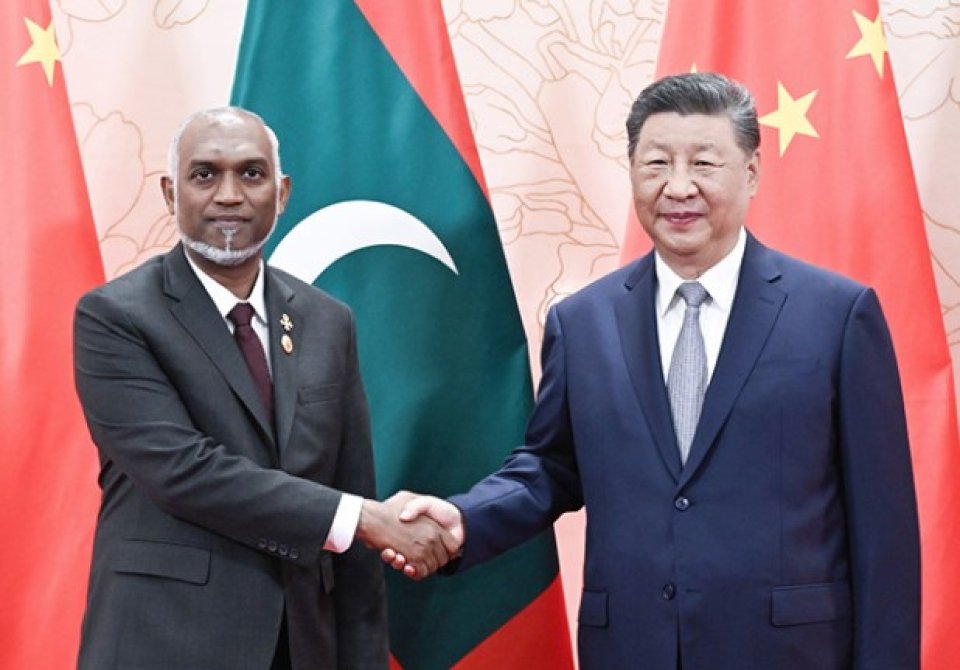
Fourteen years after Xi Jinping took the helm of China’s Communist Party, Beijing is presenting the period as one of sweeping economic and social transformation — from poverty reduction and industrial expansion to green technology and artificial intelligence — while increasingly linking its development experience to partnerships with countries including the Maldives.
When Xi Jinping appeared before Chinese and international journalists at Beijing’s Great Hall of the People in November 2012 as the newly elected General Secretary of the Communist Party of China, he set out what would become one of the defining themes of his leadership.
“The people’s aspiration for a better life is the goal for which we strive,” Xi said.
Fourteen years later, China has undergone significant changes in its economy, infrastructure, technology and international engagement. Beijing credits much of that transformation to long-term policy planning under Xi and the Communist Party of China, while its development experience continues to attract attention across the developing world.
One of the most widely recognised achievements during this period has been China's reduction of extreme poverty.
Chinese official figures say 98.99 million rural residents were lifted above the country's national poverty threshold between 2012 and 2020. The World Bank, looking at the broader period since China's economic reforms began in the late 1970s, estimates that close to 800 million people were lifted out of extreme poverty, accounting for a significant share of the global decline in extreme poverty over four decades.
A major feature of China's campaign was what Beijing called “targeted poverty alleviation” — identifying individual communities and households and tailoring assistance according to their circumstances rather than applying a single national solution.
The approach involved assessing the causes of poverty, directing officials and resources to individual villages, improving access to housing, healthcare and education, and monitoring whether households remained above poverty thresholds.
For China's leadership, the campaign became an example of how broad national objectives could be translated into measurable local programmes.
But China's transformation has extended far beyond poverty reduction.
From ‘Made in China’ to electric vehicles and AI
For decades, China's rise was closely associated with large-scale manufacturing.
Garments, electronics, household appliances and furniture helped turn the country into the world's manufacturing powerhouse as Beijing leveraged its large workforce, infrastructure investment and integration into global supply chains.
That economic model is now changing.
China has increasingly moved towards higher-value manufacturing and technology, with electric vehicles, lithium-ion batteries and solar photovoltaic products emerging as major export industries.
The three industries are often described in China as the country's “new trio”, reflecting Beijing's push towards green technology and advanced manufacturing.
Artificial intelligence, robotics, biotechnology and innovative pharmaceuticals are also emerging as major areas of investment as China attempts to move further up the global technology value chain.
The transition illustrates one of the central arguments Beijing makes about its development experience: that economic models cannot remain static and must adapt as domestic and international conditions change.
China's rapid industrial development has also brought challenges, including demographic pressures, slowing economic growth, property-sector difficulties and growing trade tensions with major economies. Nevertheless, Beijing has continued to prioritise technological self-reliance, industrial upgrading and domestic innovation.
Governance and China's anti-corruption drive
Another major feature of Xi's tenure has been a far-reaching anti-corruption campaign within the Communist Party and government.
Chinese authorities describe the campaign as part of what Xi calls the Party's “self-revolution” — the idea that a governing political organisation must continuously confront corruption, misconduct and institutional weaknesses within its own ranks.
Thousands of officials at different levels have faced disciplinary or criminal investigations since the campaign began.
Beijing argues that the effort has strengthened government accountability and public confidence. At the same time, China's political system remains highly centralised under the Communist Party, with Xi consolidating significant authority during his years in office.
The CPC maintains that internal discipline and anti-corruption enforcement are essential to maintaining its ability to govern over the long term.
Development without a single formula
China has increasingly promoted the argument that countries should pursue modernisation according to their own political, economic and social circumstances rather than adopting a single development model.
That message has become a recurring feature of China's engagement with developing countries.
Beijing says its experience is not intended to provide a ready-made blueprint for other nations, but to demonstrate the importance of long-term planning, political stability, infrastructure, human development and adaptation to changing economic circumstances.
That argument carries particular relevance for small developing states such as the Maldives, where policymakers must balance growth, infrastructure requirements, climate vulnerability, external debt and dependence on tourism.
China and the Maldives have significantly expanded cooperation over the past decade, particularly in infrastructure, housing, tourism, trade and development assistance.
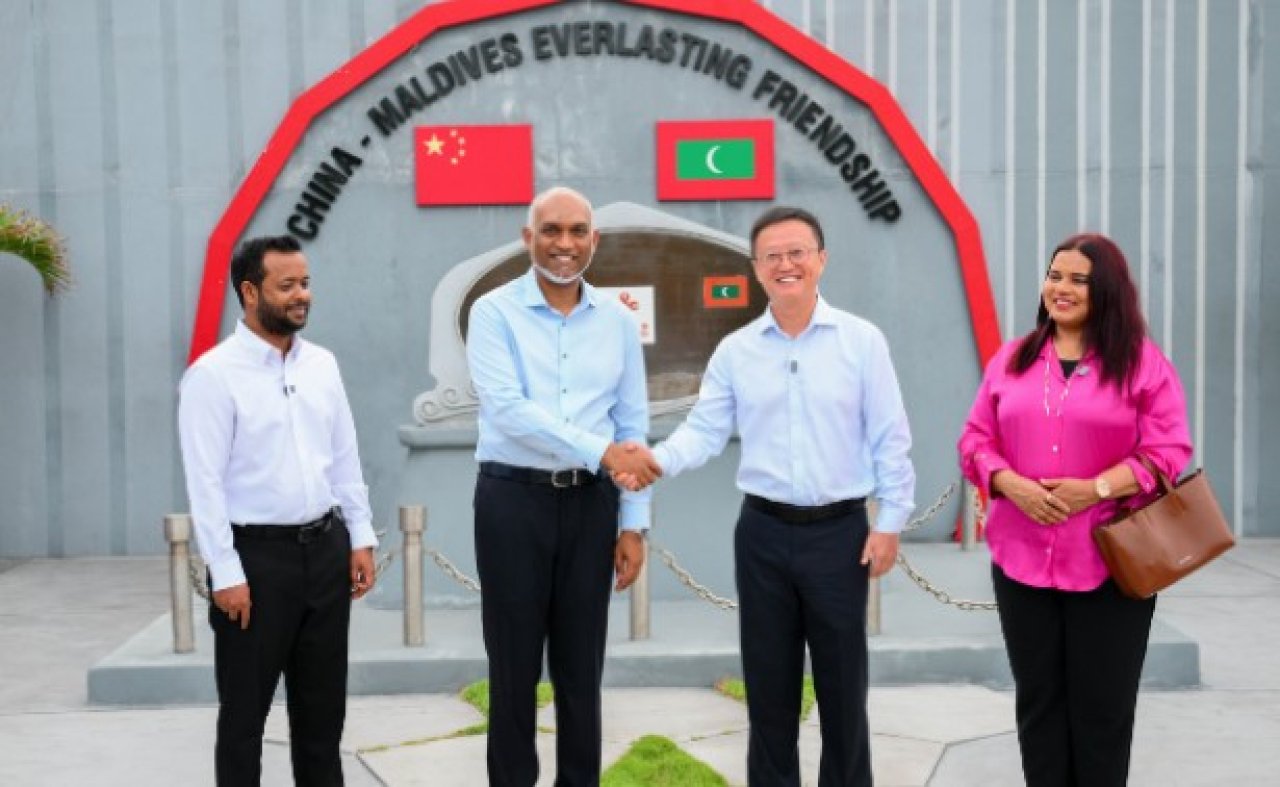
Maldives-China relationship continues to expand
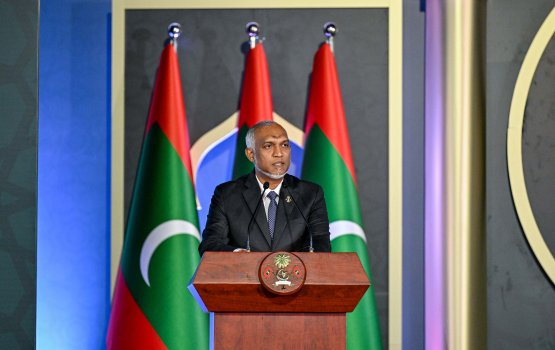
President Dr Mohamed Muizzu made his second visit to China since taking office during an official trip from late August to early September 2025.
During the visit, Muizzu met Chinese President Xi Jinping in Tianjin, with discussions covering economic development, trade, investment, security cooperation and people-to-people relations. The two governments reaffirmed their Comprehensive Strategic Cooperative Partnership covering 2024–2028.
Eleven agreements and Memoranda of Understanding were subsequently signed in Beijing covering areas including economic development, capacity building, infrastructure and renewable energy.
Several major Chinese-assisted projects are now progressing in the Maldives.
Survey and technical work for the Malé and Vilimalé Road Redevelopment Project, financed through Chinese grant assistance, began this year. The project is expected to include extensive road reconstruction and engineering measures aimed at addressing long-standing flooding problems in parts of the capital.
Another major project is the China–Maldives Friendship Hospital in Vilimalé.
An implementation agreement signed in January 2026 provides for a hospital covering approximately 12,890 square metres with 112 beds, funded through Chinese grant assistance.
Preparatory work has continued through 2026. In September, authorities announced plans to temporarily relocate services from the existing Vilimalé Hospital as preparations advance for development of the new facility at the site.
These initiatives add to an already substantial Chinese infrastructure footprint in the Maldives, most visibly represented by projects such as the China–Maldives Friendship Bridge and housing developments in the Greater Malé region.
China's wider global ambitions
China's domestic development strategy has increasingly been accompanied by a broader international agenda.
Under Xi, Beijing has promoted the Belt and Road Initiative alongside four major diplomatic frameworks — the Global Development Initiative, Global Security Initiative, Global Civilization Initiative and, most recently, the Global Governance Initiative.
China presents these initiatives as alternatives or supplements to existing international development and governance structures, particularly for developing countries seeking greater representation in global decision-making.
The Maldives has maintained close engagement with China while continuing to pursue relationships with India, the United States, Europe, the Gulf states and other international partners.
For a strategically located Indian Ocean nation, maintaining that balance remains an important element of Maldivian foreign policy.
During the 2025 Shanghai Cooperation Organisation Summit, President Muizzu described the Maldives as a resilient small state and called for greater representation of Small Island Developing States in international decision-making. He also voiced support for China's Global Governance Initiative.
Fourteen years of change
China today is considerably different from the country Xi Jinping inherited as Communist Party leader in 2012.
Its economy is larger and technologically more advanced. Extreme poverty, according to China's national definition, has been eliminated. The country has become a global leader in electric vehicles, batteries, renewable-energy manufacturing and increasingly artificial intelligence.
At the same time, China faces new domestic and international pressures — from an ageing population and economic restructuring to intensifying geopolitical and trade competition.
Beijing's argument is that development should be viewed as a continuous process rather than a finished model.
That may ultimately be the most relevant lesson for countries such as the Maldives.
China's circumstances cannot be directly replicated in a small island economy of just over half a million people. The scale, political system, resources and economic structures of the two countries are fundamentally different.
But the broader questions raised by China's experience — how governments maintain long-term development objectives, invest in infrastructure and human capital, adapt to technological change and translate national ambitions into tangible improvements in people's lives — are questions confronting every developing country.
For the Maldives, the challenge will be to find answers shaped by its own circumstances, while using international partnerships, including its expanding relationship with China, to support national priorities.
China's transformation over the past fourteen years offers one example of how quickly a country's economic priorities can evolve.
This feature is contributed by Chinese Ambassador H.E. Kong Xianhua, Maldives.