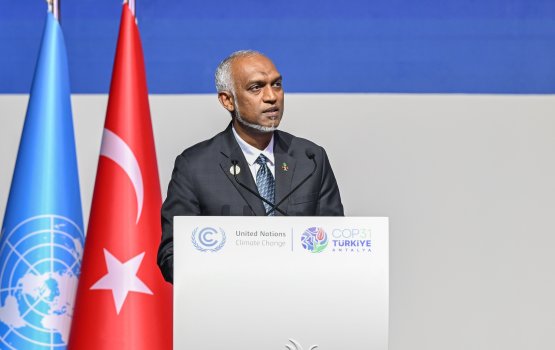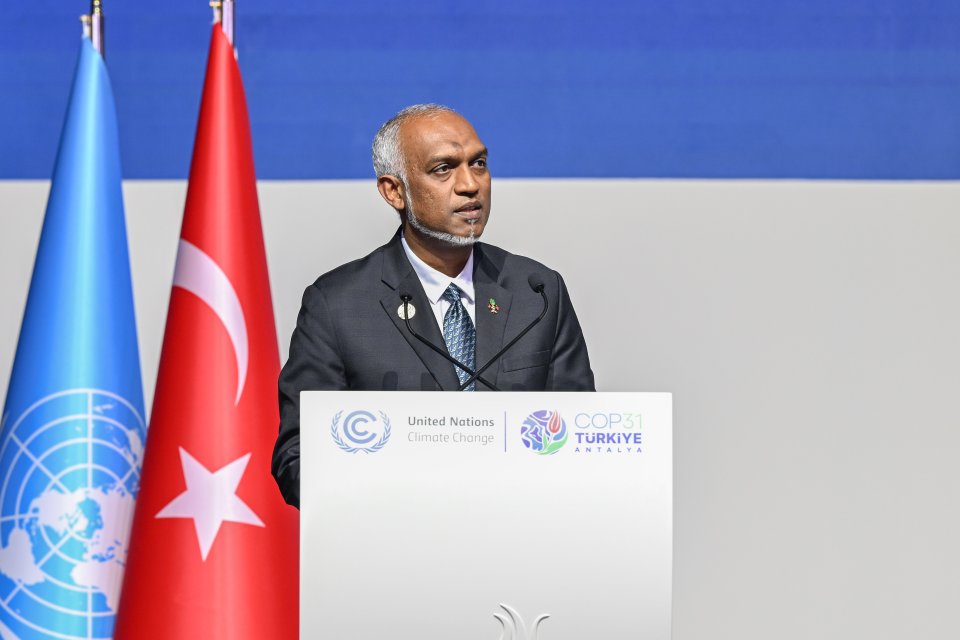

President Dr Mohamed Muizzu has called on the international community to honour its climate obligations, reform the international financial architecture and translate political commitments into measurable progress.
Delivering the Maldives’ National Statement at the 31st Session of the Conference of the Parties to the United Nations Framework Convention on Climate Change (COP31), the President outlined three priorities for collective action: finance, reform and implementation.
On climate finance, the President called for funding to be new, additional, predictable and grant-based. He also urged the replenishment of the Green Climate Fund, adequate capitalisation of the Adaptation Fund and sufficient resourcing of the Loss and Damage Fund. He stressed that vulnerable countries should not be expected to borrow their way out of a crisis they had done little to create.
The President also called for reforms to the international financial architecture to better recognise the unique vulnerabilities of Small Island Developing States (SIDS). He emphasised that international financial institutions and credit rating agencies must reassess how climate investments are evaluated, recognising resilience as an investment in the collective future rather than a financial liability.
Highlighting the Maldives’ progress on climate action, the President outlined efforts to strengthen food, energy and water security through the strategic use of limited domestic and international resources. He also highlighted the country’s progress in expanding access to climate finance.
The President further highlighted the recent accreditation of the Maldives’ first national direct access entity to the Green Climate Fund, making it the first such accreditation for an Asian Small Island Developing State. He noted that this achievement demonstrated the country’s institutional readiness to access and deliver climate finance.
Emphasising the importance of implementation, the President called for adequate financing, technology transfer and political commitment to translate climate ambitions into measurable progress. He also advocated for a global system that empowers SIDS to determine their own development pathways.