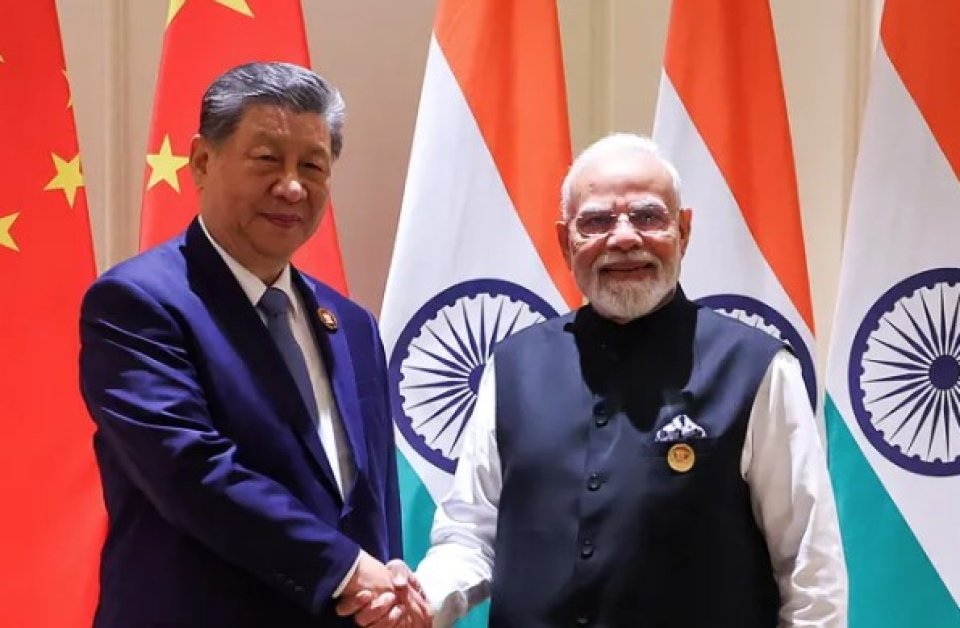

NEW DELHI -- Prime Minister Narendra Modi’s meeting with Chinese President Xi Jinping on the sidelines of the BRICS Summit has brought renewed attention to India’s effort to stabilise ties with China while dealing with a trade relationship that remains heavily tilted in Beijing’s favour.
The meeting comes as relations between the two Asian powers show signs of improvement following years of tension after the 2020 border clashes.
Direct flights have resumed, border trade through the Nathu La Pass has reopened, and India has begun easing some restrictions affecting investment from neighbouring countries.
But while political engagement is improving, the economic relationship remains far more difficult.
China is India’s largest source of imports, accounting for about 19.2 percent of the country’s total imports, according to data cited by The Indian Express.
India relies heavily on Chinese supplies of electronics, machinery, automobile components, solar equipment, batteries and a wide range of industrial inputs.
For Indian policymakers, that dependence presents a difficult challenge.
Many Indian manufacturers depend on Chinese machinery, technology and intermediate goods to remain competitive. At the same time, they face growing competition from Chinese companies both in the domestic market and abroad.
The issue is therefore not simply whether India should trade more with China, but whether that trade can become more balanced.
New Delhi has long sought greater access for Indian products in the Chinese market and wants investment that strengthens domestic manufacturing rather than increasing dependence on imports.
The Modi-Xi meeting comes against a wider backdrop of uncertainty in the global economy, with trade restrictions, tariffs, sanctions and geopolitical conflicts affecting markets and supply chains.
Those concerns were also reflected in the BRICS declaration adopted in New Delhi.
The declaration criticised unilateral economic measures, secondary sanctions and rising trade restrictions, including what it described as indiscriminate increases in tariffs.
The language was widely seen as a response to growing protectionism, particularly in the United States, although the declaration did not name Washington directly.
For India, that carefully worded position is important.
New Delhi has consistently resisted attempts to portray BRICS as an anti-Western alliance. India continues to maintain a close strategic relationship with the United States and Europe while also strengthening ties with Russia, China and countries across the Global South.
That balancing act was visible throughout the BRICS declaration.
One of the most notable omissions was Ukraine.
Unlike the 2025 BRICS declaration, which referred to the differing positions of member states on the conflict, the 2026 New Delhi declaration made no direct reference to the war.
The omission reflects the difficulty of reaching agreement within a bloc that includes Russia as well as countries maintaining strong relations with Western governments.
The declaration was more direct on Gaza and the Palestinian issue.
BRICS members opposed the forced displacement of Palestinians and reiterated calls for humanitarian access and a political solution to the conflict.
The document also referred to attacks on civilian and safeguarded nuclear facilities, a sensitive issue following strikes involving Iranian nuclear sites.
The expanded BRICS grouping now includes countries with very different regional and strategic interests, including Iran and the United Arab Emirates.
Reaching consensus among those members has become increasingly difficult, but the New Delhi summit demonstrated that the grouping can still agree on broad positions on major international issues.
India also used the summit to reinforce its call for reforms to global institutions, including the United Nations Security Council and international financial bodies.
China and Russia again expressed support for a greater role for India and Brazil in the United Nations, including in the Security Council.
For India, BRICS increasingly offers a platform to push for greater influence for developing economies without aligning fully with either the Western powers or the China-Russia camp.
But India’s relationship with China remains central to that strategy.
Both countries have strong reasons to improve ties. They are major trading partners, important emerging economies and influential members of BRICS.
Yet their relationship remains shaped by border disputes, strategic competition and a large trade imbalance.
India’s challenge is therefore unlikely to disappear even if political relations continue to improve.
The question for New Delhi is whether closer engagement with Beijing can lead to more investment, stronger Indian manufacturing and greater access to Chinese markets — rather than simply increasing India’s reliance on Chinese imports.
That issue is likely to remain one of the defining tests of the India-China relationship long after the BRICS Summit ends.
(Source: News sysdicate)