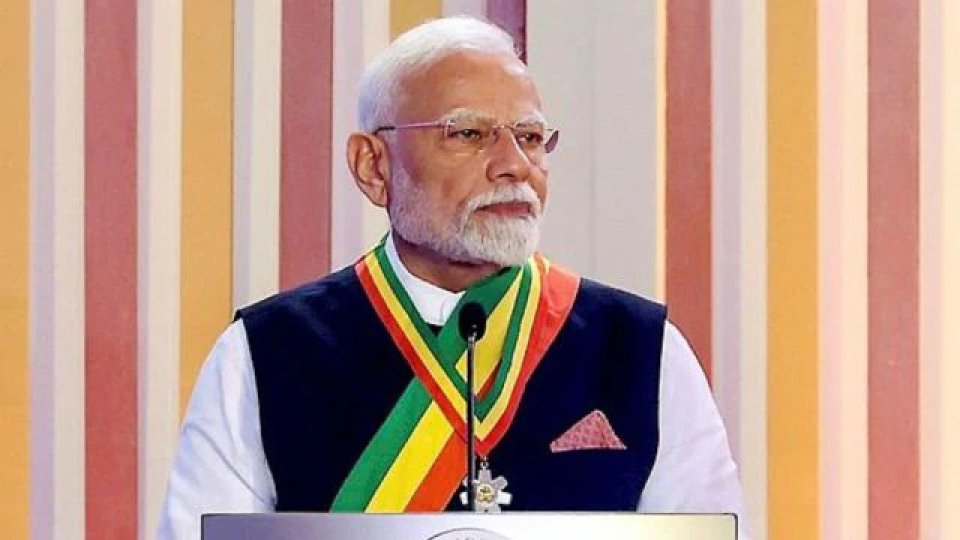

Indian prime minister to hold talks with President Shavkat Mirziyoyev before travelling to Kyrgyzstan for the 26th Shanghai Cooperation Organisation SummitNEW DELHI — Indian Prime Minister Narendra Modi on Saturday began a four-day visit to Uzbekistan and Kyrgyzstan, aimed at strengthening India’s engagement with Central Asia and advancing regional cooperation through the Shanghai Cooperation Organisation.
Modi will be in Uzbekistan from August 29 to 30 for talks with President Shavkat Mirziyoyev. The visit is expected to focus on expanding cooperation in trade and investment, digital connectivity, defence, energy and other strategic sectors.
Before his departure, Modi said he looked forward to discussing ways to further deepen the partnership between the two countries and advance their respective national development visions—India’s “Viksit Bharat,” or Developed India, and Uzbekistan’s “Yangi Uzbekistan,” meaning New Uzbekistan.
“My visit to Uzbekistan will provide an opportunity to further deepen our strategic partnership and longstanding civilisational ties,” Modi said.
The Indian prime minister is scheduled to attend a dinner hosted by Mirziyoyev on Saturday, followed by formal bilateral engagements at the Presidential Palace on Sunday. This marks Modi’s fourth visit to Uzbekistan.
The programme also includes visits to the Lal Bahadur Shastri Memorial and the Mahatma Gandhi Centre in Tashkent, highlighting the historical and cultural links between India and Uzbekistan.
Following the bilateral visit, Modi will travel to Bishkek at the invitation of Kyrgyz President Sadyr Zhaparov to attend the 26th Shanghai Cooperation Organisation Summit from August 31 to September 1.
The summit marks the 25th anniversary of the SCO, a regional grouping in which India has been a full member since 2017. Discussions are expected to cover regional security, counterterrorism, economic cooperation, connectivity and developments affecting the wider Eurasian region.
Modi is also scheduled to hold bilateral meetings with several leaders on the sidelines of the summit, including Russian President Vladimir Putin.
The two-country tour reflects India’s growing diplomatic focus on Central Asia—a region of strategic importance due to its energy resources, trade potential and location connecting South Asia, China, Russia and Europe.
The visit comes as New Delhi seeks to expand its economic and security partnerships across Eurasia while maintaining dialogue with major regional powers through platforms such as the SCO.
Sources: Prime Minister’s Office of India, Ministry of External Affairs