
Malé, August 4, 2026: Economic and diplomatic engagement between the Maldives and India strengthened during the first two quarters of 2026, with bilateral trade reaching USD 771.76 million and cooperation expanding across investment, tourism, technology, healthcare, digital payments and security.
Official figures released by India’s Ministry of Commerce and Industry show that bilateral trade increased by 13.54 percent to USD 771.76 million in the 2025–26 financial year, compared with USD 679.70 million in 2024–25.
The figures refer to India’s financial year—from April 2025 to March 2026—and should not be interpreted as the value of trade during the January–June 2026 period.
India remains the Maldives’ second-largest trading partner, according to the official statement issued by India’s Press Information Bureau.
The latest figures also point to a significant longer-term expansion in commercial ties. Bilateral trade, which stood at approximately USD 223 million in 2017–18, had risen to nearly USD 680 million by 2024–25—representing a more than threefold increase over seven years.
High-level exchanges during first quarter
Bilateral engagement during the January–March quarter covered parliamentary relations, emerging technologies, foreign policy and regional cooperation.
People’s Majlis Speaker Abdul Raheem Abdulla visited India from January 13 to 18 to participate in the 28th Conference of Speakers and Presiding Officers of the Commonwealth.
Minister of State for Homeland Security and Technology Dr Mohamed Kinaanath subsequently visited India from February 17 to 21 to attend the AI Impact Summit. His participation reflected the growing emphasis placed by both countries on artificial intelligence, digital infrastructure, cybersecurity and technological capacity-building.
Minister of State for Foreign Affairs Abdullah Hameed also visited India from March 4 to 8 to participate in the Raisina Dialogue.
Details of the visits were included in an official Indian Ministry of External Affairs record of recent bilateral and multilateral engagements.
Diplomatic and health cooperation advances in second quarter
Engagement continued during the April–June quarter when Maldives Foreign Minister Iruthisham Adam visited India from May 12 to 14.
During the visit, she met Indian External Affairs Minister Dr S. Jaishankar, with the two sides reviewing the full range of bilateral relations, according to the Indian Ministry of External Affairs.
The two countries also continued discussions on consular cooperation, including issues affecting Maldivians travelling to, studying in or receiving medical treatment in India.
Healthcare cooperation received further attention in June when India dispatched 20,000 doses of measles vaccine and approximately three tonnes of medical supplies to the Maldives.
The shipment was announced by the Indian Ministry of External Affairs on June 11, 2026, reinforcing an established healthcare partnership involving pharmaceuticals, medical supplies, professional training and emergency assistance.
Free trade negotiations move forward
Economic engagement entered a more structured phase at the end of the second quarter when the first round of India–Maldives Free Trade Agreement negotiations began virtually on June 29.
The talks continued until July 7 and involved eight technical sessions covering eight policy areas. Both sides reported substantive progress and broad convergence on several issues.
On July 8, Maldives Economic Development, Transport and Trade Minister Mohamed Saeed met Indian Commerce and Industry Minister Piyush Goyal. The ministers reviewed the progress of the FTA negotiations and other bilateral economic initiatives.
The two countries also reaffirmed their intention to expedite work on the proposed Bilateral Investment Treaty.
According to the Indian Ministry of Commerce and Industry, the countries have identified trade, investment, tourism, start-ups, digital payments and micro, small and medium-sized enterprises as priority areas for deeper cooperation.
The proposed FTA is expected to address trade in goods and services, market access, investment facilitation and broader economic cooperation. Both governments have described their objective as reaching a broad-based and balanced agreement founded on fairness and reciprocity.
India remains an important source of essential supplies
India and the Maldives signed a bilateral trade agreement in 1981 that provides a framework for supplying essential commodities to the Maldives.
Indian exports to the Maldives include food and agricultural commodities, medicines and pharmaceuticals, machinery, engineering and industrial products, radar equipment, construction materials and rock boulders.
The Maldives’ dependence on imports makes access to nearby Indian markets especially important for maintaining supplies required by households, businesses, infrastructure projects and the tourism industry.
The principal Indian exports include rice, flour, sugar, onions, potatoes, eggs, construction aggregates, machinery and pharmaceutical products. A February 2026 bilateral brief published by the High Commission of India in the Maldives identifies pharmaceuticals, engineering products, industrial goods, radar equipment and rock boulders among the products exported to the Maldives.
Maldivian exports and commercial interests are concentrated largely in fisheries and marine products, tourism and tourism-related services. A future FTA could provide Maldivian companies with improved access to India’s consumer market while encouraging additional Indian investment in the Maldives.
Partnership broadens beyond conventional trade
The first six months of 2026 showed that the economic relationship is moving beyond merchandise trade into technology, finance and service-sector cooperation.
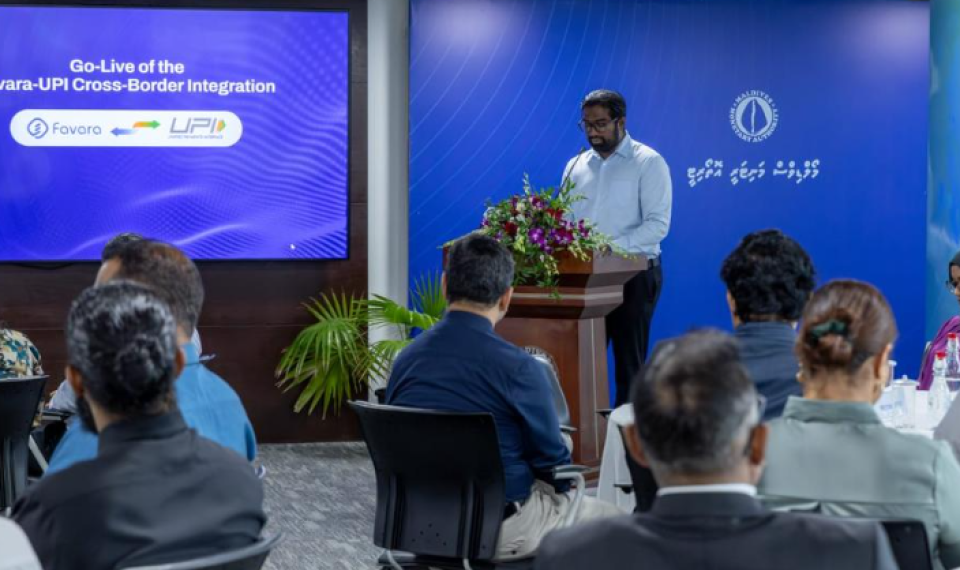
Digital-payment connectivity could simplify transactions for travellers, patients, students, workers and businesses. Cooperation between start-ups and MSMEs could also open opportunities for Maldivian enterprises in areas including tourism technology, fisheries, food processing, logistics and digital services.
Tourism remains another important component of the relationship because of India’s role as a source market for Maldivian tourism and the extensive air links between the two countries.
Meanwhile, bilateral cooperation continues in infrastructure, community-development projects, education, training, defence, maritime safety, disaster preparedness and capacity-building.
The combination of growing trade, sustained high-level exchanges and formal negotiations on an FTA and investment treaty indicates that the Maldives–India relationship is entering a broader and increasingly institutionalised phase.
Source note: The USD 771.76 million figure covers India’s April 2025–March 2026 financial year.