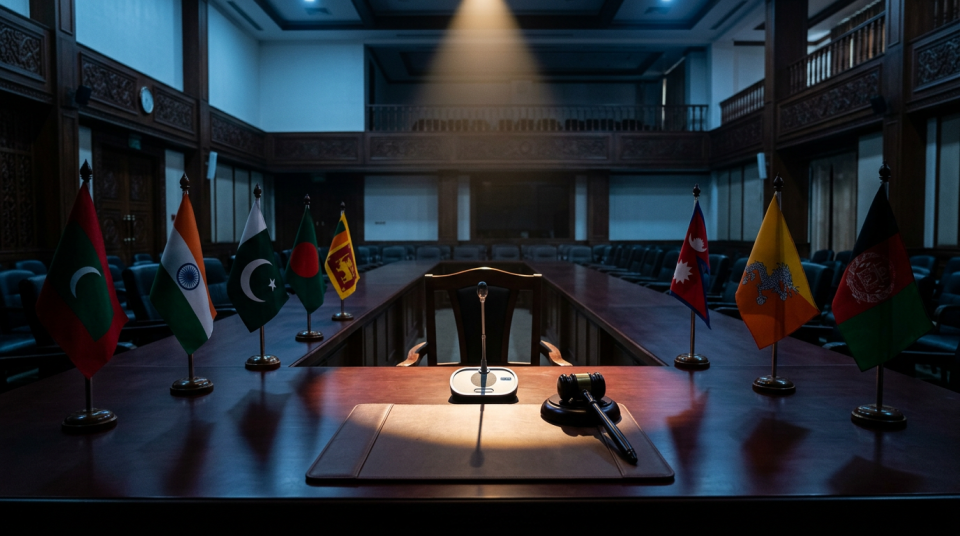

President of the Republic of Maldives Mohamed Muizzu’s offer to mediate has returned SAARC to the regional agenda. However, the India–Pakistan confrontation, SAARC’s unanimity rule and the emergence of alternative regional groupings make a leaders’ summit increasingly difficult to revive.
India has responded to President Mohamed Muizzu’s call for the revival of the South Asian Association for Regional Cooperation (SAARC) by pointing towards Pakistan as the country responsible for obstructing the regional organisation.
Responding to questions following Muizzu’s remarks, Indian Ministry of External Affairs spokesperson Randhir Jaiswal said India favoured strong regional cooperation but maintained that cooperation required goodwill.
“Everyone in South Asia is aware of which country and what activities are actually stymying SAARC,” Jaiswal said, without directly naming Pakistan.
The remarks reflected India’s longstanding position that meaningful regional engagement cannot resume while Pakistan allegedly allows its territory to be used by groups responsible for cross-border terrorism.
Pakistan has consistently rejected India’s allegations and has accused New Delhi of using bilateral disagreements to prevent the resumption of the SAARC process.
The exchange has once again exposed the central problem confronting SAARC: the organisation was established to promote regional cooperation but possesses no effective mechanism for managing the political and security disputes between its two largest members.
Muizzu offers Maldives as mediator
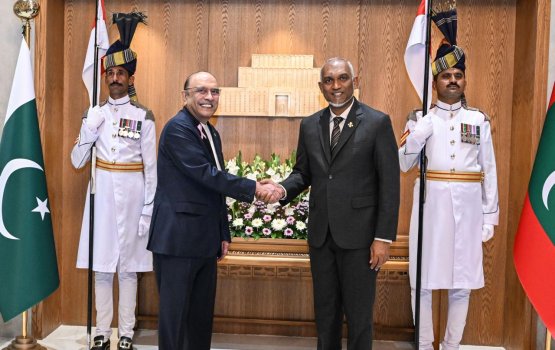
President Muizzu called for renewed dialogue among SAARC members during his address at the Maldives’ 61st Independence Day ceremony on July 26.
According to the President’s Office, Muizzu referred to the continuing impasse within SAARC and urged member states to return to the negotiating table in the interests of regional peace and cooperation.
He also said the Maldives was prepared to serve as a mediator.
The statement was delivered before 113 diplomats representing 43 countries and international organisations, giving the proposal a deliberately international platform.
Muizzu did not publicly set out a mediation framework, identify the parties to be mediated between or propose a date for a ministerial or leaders’ meeting. His offer should therefore be understood as a political initiative rather than an agreed diplomatic process.
Nevertheless, the intervention is significant. The Maldives is one of SAARC’s smaller members, does not share the territorial disputes that divide India and Pakistan and maintains diplomatic relations with both countries. This could allow Malé to function as a neutral venue for preliminary talks.
However, the Maldives has limited leverage over the security concerns at the centre of the India–Pakistan confrontation. A Maldivian initiative would therefore require prior acceptance from New Delhi and Islamabad before it could move beyond an expression of willingness.
A practical first step could be an informal retreat of SAARC foreign secretaries or senior officials in Malé, without immediately attempting to convene a summit. Such a meeting could concentrate on less contentious areas including climate adaptation, disaster response, public health, food security, tourism, maritime safety and student exchanges.
A summit process frozen since 2014
SAARC was established in Dhaka in 1985 and comprises Afghanistan, Bangladesh, Bhutan, India, Maldives, Nepal, Pakistan and Sri Lanka.
The last leaders’ summit was held in Kathmandu in November 2014. The 18th SAARC Summit Declaration called for deeper regional integration and accepted Pakistan’s offer to host the next summit.
The 19th summit was scheduled to take place in Islamabad in November 2016. India announced that it would not attend following the attack on an Indian military installation in Uri, which New Delhi attributed to militants operating from Pakistan.
Afghanistan, Bangladesh and Bhutan also withdrew, leaving the summit without the consensus required to proceed. It was subsequently postponed indefinitely.
No SAARC leaders’ summit has been held since.
The organisation has not been formally dissolved. Its Secretariat remains in Kathmandu, and some specialised institutions and technical programmes continue functioning. The SAARC Cultural Centre, for example, continues to conduct research, cultural programmes and regional activities in 2026.
SAARC is therefore institutionally alive but politically paralysed.
Who is responsible?
Responsibility for SAARC’s paralysis is not equal, but neither can it credibly be assigned to only one country.
Pakistan carries the central security burden
India’s refusal to resume summit-level engagement is based primarily on allegations that Pakistan has failed to take credible action against groups involved in attacks against India.
The cancellation of the 2016 summit followed a major security incident rather than an ordinary diplomatic disagreement. Bangladesh and Afghanistan also had security grievances against Pakistan at the time, contributing to Islamabad’s regional isolation.
This gives Pakistan the heavier substantive burden in the dispute. Unless Islamabad can produce measures that India considers credible on cross-border terrorism, New Delhi is unlikely to reconsider its position.
Pakistan argues that India is applying a political precondition that does not exist in the SAARC Charter and that disputes should be addressed through dialogue rather than through the suspension of regional institutions.
India possesses the decisive procedural veto
India is SAARC’s largest economy and the only member with land or maritime proximity to almost every other member. No meaningful South Asian integration project can operate without Indian participation.
India did not create all the conditions that led to the crisis. However, its decision to withhold participation has the practical effect of freezing the summit process.
New Delhi has also developed alternative channels of regional cooperation, including BIMSTEC, BBIN and project-based arrangements linking India with Bangladesh, Bhutan, Nepal, Sri Lanka and the Maldives. These platforms allow India to pursue regional connectivity without Pakistan.
India consequently carries the heavier procedural responsibility: regardless of the original cause, the organisation cannot return to summit-level activity unless New Delhi agrees.
SAARC’s Charter turns disagreement into paralysis
The third source of responsibility lies within SAARC itself.
Article X of the SAARC Charter requires all decisions to be taken unanimously. It also excludes bilateral and contentious issues from formal deliberations.
These provisions were originally intended to protect smaller states and prevent bilateral disputes from dominating regional cooperation. In practice, they have produced a contradiction.
The India–Pakistan dispute is powerful enough to stop SAARC, but SAARC is prohibited from formally addressing that dispute. Meanwhile, the unanimity requirement allows any member to prevent the organisation from advancing.
SAARC therefore lacks both the authority to resolve its main political problem and the flexibility to work around it.
Other members have limited influence
Bangladesh, Bhutan, Maldives, Nepal and Sri Lanka favour greater regional cooperation, but they have not been able to create a sustained diplomatic process acceptable to both India and Pakistan.
Afghanistan presents an additional complication because of questions surrounding the regional and international recognition of its present authorities. However, Afghanistan is not the original cause of SAARC’s paralysis.
Smaller members should not carry the same responsibility as India and Pakistan, but their inability to maintain a coordinated revival initiative has allowed the deadlock to become normalised.
Bangladesh proposes a functional revival
Bangladesh has emerged as another leading advocate of reviving SAARC.
Bangladesh State Minister for Foreign Affairs Shama Obaed has argued that the organisation remains important to the country’s regional policy but requires stronger institutions and more reliable implementation.
According to the Dhaka Tribune, Obaed identified limited implementation capacity, inadequate financial resources and weak institutional follow-up as major shortcomings.
She proposed that SAARC should operate at an “optimal functional level” until the political environment becomes suitable for another summit.
Bangladesh has also suggested consultations on convening a meeting of senior officials and examining the possibility of a special session of the SAARC Council of Ministers.
This approach is more immediately achievable than attempting to organise a leaders’ summit. It would allow practical cooperation to resume without requiring India and Pakistan to announce that their wider political disputes had been resolved.
Obaed has also argued that SAARC and BIMSTEC should not be treated as competing organisations. Her position is that the two groupings can operate alongside each other, with SAARC covering South Asia and BIMSTEC linking South Asia with the wider Bay of Bengal region.
Maldives and Bangladesh are therefore proposing two complementary approaches: Muizzu is offering political mediation, while Dhaka is advocating institutional and technical reactivation.
South Asia’s lost trade opportunity
SAARC’s political weakness has had measurable economic consequences.
The World Bank estimates that trade within South Asia represents only around five percent of the region’s total trade—far below levels recorded in more integrated regions.
A World Bank study estimated that intraregional merchandise trade could increase from approximately USD 23 billion to at least USD 67 billion if tariffs, non-tariff restrictions, transport barriers and the regional trust deficit were reduced.
These are historical regional estimates rather than 2026 trade totals, but they illustrate the size of the unrealised opportunity.
Selected bilateral merchandise figures reported through UN Comtrade show that trade continues, but it is concentrated heavily around India and remains far below the region’s potential.
The figures use the latest complete calendar year available for each selected corridor and cover merchandise rather than services. Tourism, aviation, financial services and informal border trade are not included.
The table also demonstrates SAARC’s central economic imbalance. Most of the organisation’s substantial trade corridors involve India, while direct trade between India and Pakistan—the two largest SAARC states—has been reduced to a fraction of its potential.
The World Bank previously estimated that India–Pakistan trade alone could reach USD 37 billion under normalised conditions, compared with around USD 2 billion at the time of its assessment.
Who benefits from keeping SAARC stalled?
No SAARC member receives a clear net economic benefit from the organisation’s paralysis. However, some countries and political actors obtain relative strategic or domestic advantages.
India gains greater control over regional cooperation
India possesses the greatest strategic flexibility while SAARC remains stalled.
It can pursue trade, infrastructure, energy and security initiatives through bilateral agreements or groupings that exclude Pakistan. This allows New Delhi to cooperate with receptive neighbours without giving Islamabad an equal place at the table.
A stalled SAARC also supports India’s strategy of diplomatically isolating Pakistan over terrorism-related concerns.
However, this is only a relative political advantage. India also loses access to a larger integrated regional market and faces greater opportunities for external powers to expand their influence among neighbouring countries.
Security and nationalist interests in Pakistan may benefit
Pakistan as a country suffers economically and diplomatically from SAARC’s failure. Its exporters lose easier access to the Indian market, while Islamabad’s ability to influence regional economic rules is reduced.
However, elements within Pakistan’s security and nationalist establishment may benefit domestically from continued confrontation. Regional normalisation would require politically difficult compromises, stronger accountability over militant organisations and a reduction in the India-centred security narrative.
These are narrow institutional or political benefits rather than benefits for Pakistan’s economy or population.
China gains an indirect strategic opportunity
China is not responsible for the original SAARC deadlock and is not a SAARC member. Nevertheless, weak regional integration creates more room for Beijing to build bilateral influence through infrastructure financing, trade and the Belt and Road Initiative.
If South Asian states cannot develop regional transport, energy and financing mechanisms among themselves, they become more dependent on external partners.
China therefore gains a relative strategic opportunity from the vacuum, although it should not be portrayed as the cause of the India–Pakistan confrontation.
Protectionist and informal interests also gain
Businesses protected by high tariffs, inefficient border procedures or restrictions on regional competition may benefit from the absence of a functioning regional market.
Informal traders, smuggling networks and intermediaries can also profit when legitimate cross-border trade is expensive or prohibited.
Consumers, smaller exporters, tourism operators and border communities carry much of the resulting cost.
Why a full revival remains unlikely
Muizzu’s offer has diplomatic value, but a full SAARC revival remains unlikely under present conditions for five reasons.
First, India views action against cross-border terrorism as a requirement for engagement, while Pakistan rejects India’s allegations and opposes security-related preconditions.
Second, SAARC cannot formally discuss the bilateral dispute responsible for stopping its meetings.
Third, every decision requires unanimity, meaning one member can prevent an initiative from proceeding.
Fourth, India and several other members now have alternative regional and bilateral platforms. The political cost of bypassing SAARC is therefore lower than it was a decade ago.
Fifth, the organisation has weak implementation, financing and enforcement mechanisms. Even before the summit process collapsed, many declarations were not translated into completed regional projects.
This does not mean that SAARC can never function again. It means that a ceremonial return to a leaders’ summit is less realistic than a phased, functional revival.
The most credible route would begin with senior officials, followed by a special Council of Ministers meeting and cooperation in non-controversial areas. Only after a period of sustained technical engagement should member states attempt another summit.
The Maldives could contribute by hosting discreet consultations and working jointly with Bangladesh, Nepal and Sri Lanka on a limited agenda. Such an effort would not immediately resolve the India–Pakistan confrontation, but it could prevent the remaining SAARC institutions from becoming irrelevant.
For now, SAARC survives as a regional promise without a political engine. President Muizzu has offered the Maldives as a bridge, but whether that bridge can be used will ultimately be decided in New Delhi and Islamabad.
Sources and data references
Maldives President’s Office: Independence Day address and mediation offerIndia’s response to Muizzu’s SAARC proposal. SAARC Charter. Official declaration of the 18th SAARC Summit. SAARC Secretary-General on the absence of summits since 2014. Bangladesh’s proposals for a functional SAARC revival. Bangladesh on SAARC and BIMSTEC operating together. World Bank: South Asian regional trade. World Bank: A Glass Half Full—The Promise of Regional Trade in South Asia. United Nations Comtrade database. India–Bangladesh exports and importsIndia–Nepal exports and imports. India–Sri Lanka exports and imports. India–Bhutan exports and imports. Pakistan–Afghanistan exports and imports. India–Maldives exports and imports. SAARC Secretariat. SAARC Cultural Centre’s continuing 2026 activities.