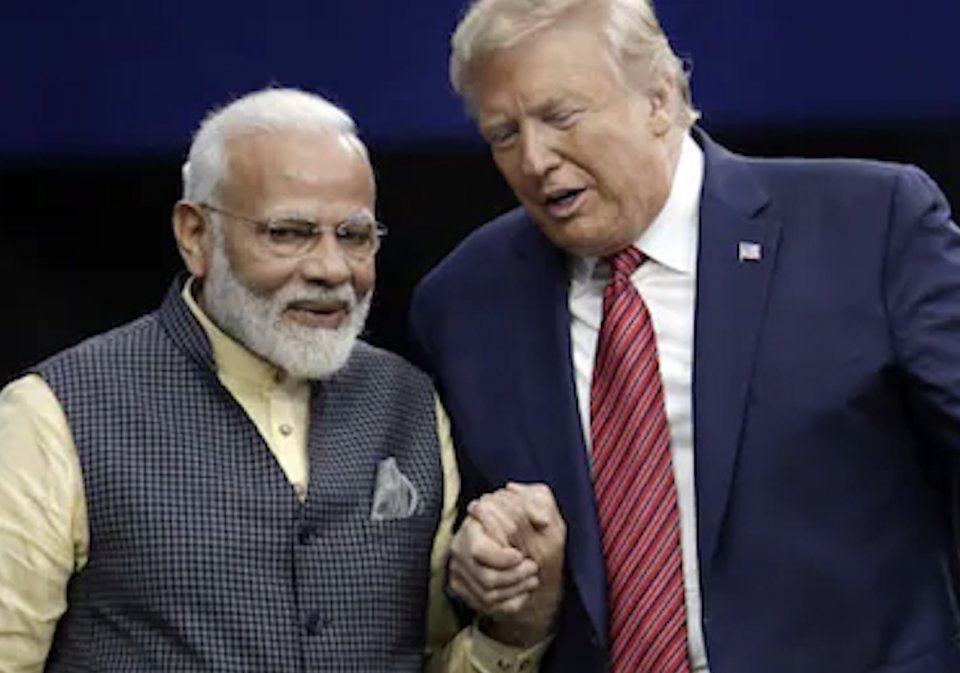
US President Donald Trump has expressed confidence that the United States and India will reach a trade agreement, describing Indian Prime Minister Narendra Modi as a close friend and highlighting the strong relationship between the two leaders.
Speaking to reporters at the White House, Trump said ongoing negotiations between Washington and New Delhi were expected to result in a deal despite recent trade disputes and tariff-related disagreements.
"We will get to a deal because I like your prime minister a lot. He is a good friend of mine, and we get along well. We have a good relationship," Trump said.
The remarks come as both countries continue discussions on an interim Bilateral Trade Agreement (BTA), aimed at expanding trade and addressing tariff-related concerns between the world's largest and fifth-largest economies.
During the interaction, Trump reiterated his longstanding criticism of India's tariff regime, arguing that New Delhi had maintained high duties on certain American products for years.
"For years, India took advantage of the United States. They charged us tremendous tariffs and paid nothing. Now it is the exact reverse, and we are making a lot of money with India," he said.
A US trade delegation visited India earlier this week for negotiations on the proposed interim agreement. India's Commerce Ministry described the talks as constructive and said both sides reaffirmed their commitment to concluding a mutually beneficial arrangement that strengthens bilateral trade and economic cooperation.
The negotiations are taking place against the backdrop of new tariff measures announced by Washington. The United States recently imposed an additional 12.5 per cent tariff on imports from 54 countries, including India, citing concerns that certain imported goods may have been produced through forced labour.
The list also includes countries such as Australia, China, Israel, Japan, Qatar and Russia.
Trump also revisited the issue of tariffs on Harley-Davidson motorcycles, a longstanding point of contention in bilateral trade discussions. He argued that high import duties had previously limited the company's ability to compete in the Indian market.
"In the past, they wouldn't let Harley-Davidson sell its motorcycles. They charged a 200 per cent tariff," Trump said, noting that the company later established manufacturing operations in India.
He contrasted the situation with US market access policies, stating that Indian motorcycle manufacturers have faced fewer barriers when exporting to the United States.
Trade discussions between the two countries have evolved significantly since the framework for the first phase of a Bilateral Trade Agreement was outlined following a phone conversation between Trump and Modi earlier this year.
Under the proposed framework, Washington had indicated its willingness to reduce tariffs on certain Indian exports and ease some trade restrictions. However, the process was complicated after the US Supreme Court ruled against a number of reciprocal tariff measures introduced under the International Emergency Economic Powers Act (IEEPA).
Following the ruling, the Trump administration announced a temporary 10 per cent tariff on imports from all countries for a period of 150 days while broader trade policies were reviewed.
India and the United States have since continued negotiations to finalise a trade arrangement that reflects the changing legal and economic landscape. (Source: NDTV)